Financial Aid Tips

Table of Contents
▸ Meet Ms. Linda Bedeau
Linda Bedeau has coached many students through college, and she put together the resources for this page. She will be our guide!
Jump to top of page:
How do I Pay for College?
Paying for college or professional school can feel overwhelming, but you do not have to figure it out alone. American Indian and Alaska Native students may be able to combine federal and state financial aid, Tribal assistance, scholarships, grants, work-study, employer benefits, tuition programs, and student loans to support their education.
This page can help you understand different types of financial support, prepare for expenses beyond tuition, find healthcare-specific opportunities, and plan for each stage of the financial aid process. Eligibility varies among programs. Some opportunities are available to enrolled Tribal members/citizens, while others may be available to documented descendants or students who meet other requirements. Begin early, complete the FAFSA, contact your Tribal education office, and confirm current eligibility and deadlines before applying.
Start Here:
1. Complete the FAFSA.
Submit it every year by the earliest applicable school, state, or federal deadline.
2. Contact your Tribal education office.
Ask about scholarships, tuition assistance, emergency aid, and support for books, housing, transportation, or childcare.
3. Search for scholarships and tuition programs.
Apply separately for Tribal, college, community, IHS, and profession-specific opportunities.
4. Compare the full cost.
Include tuition, fees, housing, food, books, transportation, technology, childcare, and clinical expenses.
Jump to top of page:
▸ Ms. Bedeau, where should I start?
Jump to top of page:
Understand Your Options
Scholarships: Awards that usually do not have to be repaid. Eligibility may be based on Tribal enrollment or descent, financial need, academic achievement, leadership, community involvement, field of study, or career goals. Some scholarships include academic or service requirements.
Grants: Grants are labeled as financial assistance that generally do not have to be repaid. They may be awarded by the federal government, a state, a Tribal Nation, a college or university, a foundation, or another organization. Some grants are based on financial need, while others focus on a student’s field of study, academic progress, community service, Tribal affiliation, or commitment to work in an underserved community.
Students should complete the FAFSA® Application | Federal Student Aid for every academic year in which they want financial assistance. The FAFSA is free and is used by colleges and career schools to determine eligibility for federal grants, work-study, and student loans. Many states, colleges, Tribal education programs, and scholarship organizations also use FAFSA information when awarding their own assistance. Completing the FAFSA does not require a student to accept a loan.
Where to look for grants and scholarships:
- College financial aid office: Ask about federal and state grants, institutional grants, emergency assistance, tuition waivers, and scholarships offered by the medical, nursing, dental, pharmacy, public-health, behavioral-health, or allied-health program.
- Tribal education or higher-education office: Ask about Tribal grants, scholarships, tuition assistance, and help with books, transportation, housing, childcare, clinical supplies, or other education-related costs.
- Indian Health Service: Review the IHS Scholarship Program for current pathways and eligibility requirements.
- Native scholarship organizations. Search the IHEART database, NativeForward, and similar spaces for opportunities available to American Indian and Alaska Native students.
- Professional associations and employers: Ask associations in your intended profession, local hospitals and clinics, Tribal and Urban Indian health programs, and current employers about scholarships, paid training, internships, or tuition assistance.
Begin early and apply to every program for which you appear eligible. Deadlines, award amounts, covered expenses, Tribal documentation requirements, and service obligations vary. Ask each program whether the FAFSA is required, whether the award is renewable, how funds may be used, and whether repayment or service is required if you withdraw, change programs, or do not complete the award conditions.
Tribal financial assistance: Support offered through a Tribal Nation's education, scholarship, workforce, or higher-education office. Each Tribe establishes its own eligibility requirements, applications, covered expenses, and deadlines.
Tuition waivers or tuition benefits: Programs that reduce or remove eligible tuition charges. They do not necessarily cover fees, books, housing, transportation, childcare, or other expenses. Programs and eligibility vary by state and institution.
Work-study and employment: Federal work-study and other campus jobs allow students to earn money through employment. Paid internships and assistantships may also help students gain experience related to their field.
Student loans: Borrowed funds that generally must be repaid with interest. Use scholarships, grants, Tribal assistance, tuition programs, and employment first. If a gap remains, compare federal and private loans carefully and borrow only what you need. Check out sites like CFPB to compare options. Protect your financial future by borrowing only what is necessary to cover your educational expenses. Before accepting a loan, make sure you fully understand the interest rate and repayment terms. If anything is unclear, contact the financial aid office and ask for an explanation before making your decision. Borrow ONLY what you need.
Loan repayment programs: Programs that may repay qualifying student debt in exchange for eligible employment or healthcare service. Eligibility, funding, and repayment are not guaranteed, so verify all requirements before borrowing or accepting a position.
Jump to top of page:
Healthcare-Specific Opportunities: Service Programs
Students preparing for healthcare careers may qualify for scholarships or service-based assistance connected to a particular profession, degree, license, employer, or worksite. Review current requirements before making borrowing, education, or employment decisions.
Indian Health Service (IHS) Scholarship Program
The IHS Scholarship Program offers several scholarship pathways. The final webpage should preserve this distinction: descendant eligibility may apply to Preparatory and Pre-Graduate scholarships, while the Health Professions Scholarship has more specific Tribal membership and service requirements.
IHS Scholarship Program
Review the scholarship comparison information and current application requirements.
IHS Loan Repayment Program
After completing an eligible health-professions program, some clinicians may qualify for IHS loan repayment. The program provides assistance for qualifying education loans in exchange for service at an eligible Indian health facility. The profession, license, loans, employer, position, and worksite must satisfy program rules.
HRSA Health Workforce Programs
The Health Resources and Services Administration administers scholarship and loan repayment opportunities for eligible nurses, primary care clinicians, behavioral health professionals, dental professionals, and other healthcare providers.
Jump to top of page:
Plan for Costs Beyond Tuition
Tuition is only one part of the cost of attending college or professional school. Ask each school for its complete cost of attendance and whether education-related expenses can be considered when determining aid eligibility.
Costs to consider:
- Fees, required equipment, books, access codes, and supplies
- Housing, utilities, deposits, food, and personal necessities
- Transportation, parking, fuel, airfare, or temporary housing
- Computer equipment and internet access
- Health insurance, medical expenses, and required immunizations
- Childcare or dependent-care expenses
- Licensure examinations, background checks, uniforms, and clinical supplies
- Travel and temporary housing for clinical rotations
Look for Support Beyond Tuition
Many colleges provide services that can reduce students' out-of-pocket costs. Ask the admissions office, financial aid office, student services office, and Native student center about available support.
Resources include:
- On-campus or subsidized childcare and student-parent support
- Emergency grants, food pantries, or meal assistance
- Transportation passes and temporary housing assistance
- Textbook lending and laptop-loan programs
- Tutoring, wellness services, Native student centers, career advising, and paid internships
Jump to top of page:
▸ Ms. Bedeau, should I get a loan?
Jump to top of page:
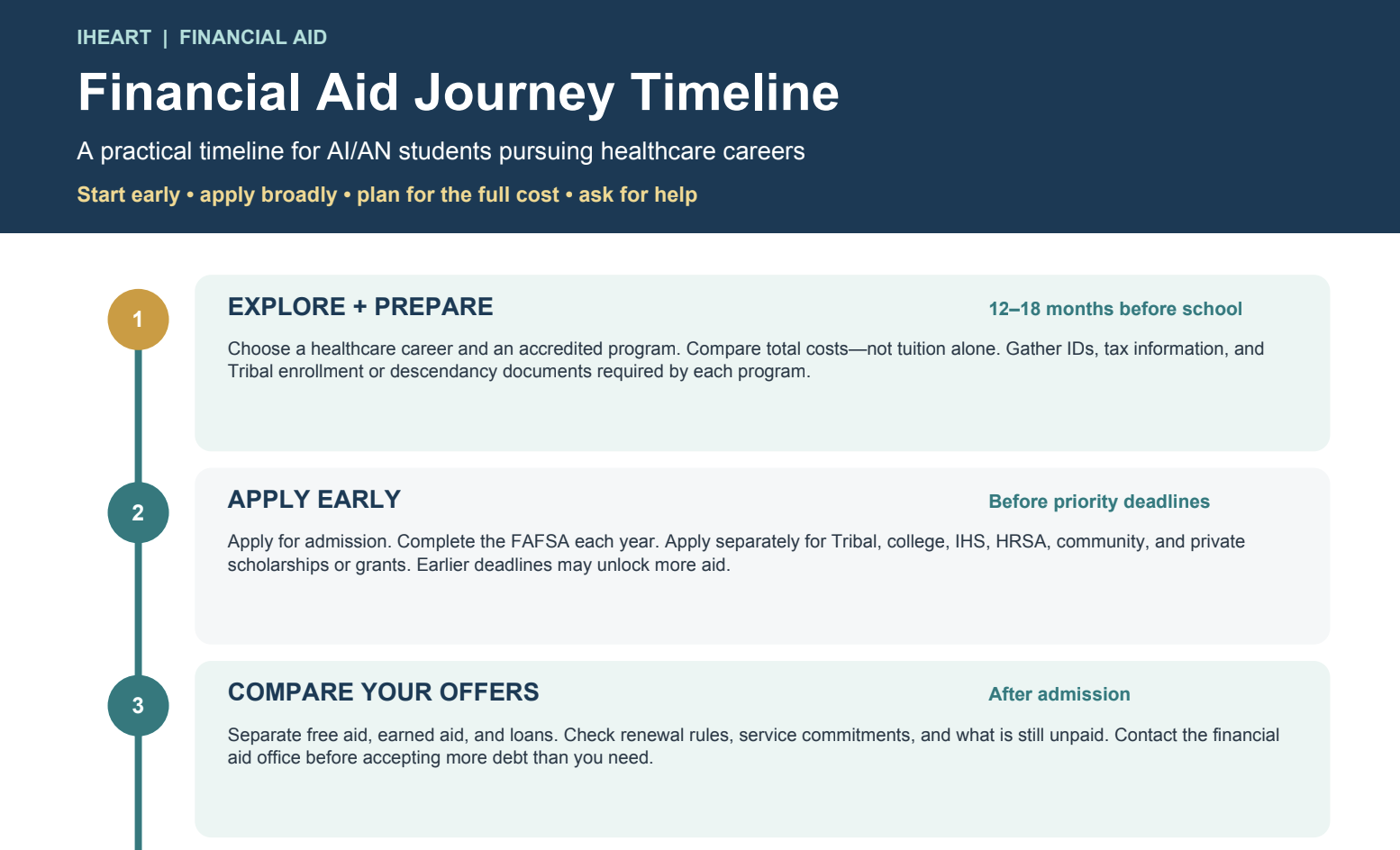
Suggested Financial Aid Timeline
Before Applying
- Explore healthcare careers and required education.
- Compare accreditation, program length, licensing outcomes, and total cost.
- Create a scholarship calendar and request recommendations early.
- Gather Tribal enrollment or descendancy documentation requested by programs.
When Applying
- Apply for admission by each school's deadline.
- Complete the FAFSA as early as possible. (Deadlines on FAFSA website)
- Contact your Tribal education office.
- Apply separately for Tribal, IHS, college, community, and profession-specific aid.
- Save applications and confirmation notices.
After Receiving an Aid Offer
- Compare the complete cost of attendance with the aid offered.
- Separate scholarships and grants from work-study and loans.
- Identify the remaining funding gap.
- Confirm renewal, academic, and service requirements.
- Borrow only what is necessary after considering other assistance.
While Enrolled
- Reapply for FAFSA, Tribal aid, and scholarships each year.
- Maintain required academic progress and enrollment status.
- Track borrowing and keep copies of agreements.
- Continue looking for paid internships and emergency assistance.
Before Graduation
- Complete required loan exit counseling.
- Confirm your total balance and loan servicer.
- Investigate IHS, HRSA, employer, state, and public-service repayment opportunities.
- Verify eligibility before accepting a position based on an expected repayment benefit.
Deadline reminder: School, state, and federal deadlines differ. Apply by the earliest deadline that applies to you.
Download a pdf of the Financial Aid Journey Timeline to add your own notes and keep track of your timeline.
Jump to top of page:
Application Materials Checklist
Scholarship and financial aid applications may require several documents. Follow each
program's instructions exactly and allow enough time to obtain official records.
Documents to gather:
- Personal statement or application letter
- Recommendation letters
- Transcripts and résumé
- Proof of Tribal enrollment or documented descendancy
- Financial information and FAFSA confirmation
- Documentation of admission or enrollment
- Essays about career goals, leadership, community involvement, or plans to serve Native communities
Jump to top of page:
Frequently Asked Questions
What Is a Scholarship?
A scholarship is money awarded to help a student pay for education. Scholarships may be offered by colleges, Tribal Nations, Tribal colleges and universities, foundations, employers, professional associations, government agencies, and community organizations.
Most scholarships do not have to be repaid, but they may include conditions. Before
accepting an award, confirm whether it is renewable, what academic or enrollment status must be maintained, what expenses it covers, and whether it includes employment or a service commitment.
What Is a Tuition Waiver?
A tuition waiver reduces or removes some or all eligible tuition charges. It is not usually
money paid directly to the student. There is no single nationwide Native student tuition-
waiver program, and being AI/AN does not automatically make college free.
Eligibility and coverage vary by state and institution. A waiver may not cover fees, books, housing, food, transportation, childcare, or clinical expenses. Ask whether the FAFSA is required, whether the waiver renews, and whether it can be combined with grants and scholarships.
What Is a Loan Repayment Program?
A loan repayment program may pay qualifying educational loans after required education or training is completed. Healthcare programs commonly require participants to work for a specified period in an eligible profession, community, facility, or service area.
Before relying on repayment assistance, verify that your profession, license, loans, employer, position, worksite, and service plan qualify. Ask about taxes, payment timing, concurrent service programs, and the consequences of changing employers or not completing the commitment. Never borrow based only on expected repayment or
forgiveness.
What Is a Grant?
A grant is financial assistance from a government, a Tribe, a college, a foundation, or
another organization. Grants are often based on financial need, although some are
connected to a field of study, population, institution, or public purpose.
Grants usually do not have to be repaid, but repayment may be required in certain
circumstances, such as withdrawal, an overpayment, a change in enrollment status, or
failure to complete a grant-specific service requirement.
How Are These Different from Financial Aid?
Financial aid is the broad term for resources that help students pay for education. An aid offer may contain scholarships, grants, tuition waivers, work-study, loans, and other
institutional assistance.
Compare how much free assistance is, how much must be earned, how much must be
repaid, what requirements apply, and how much of the school's total cost remains
uncovered.
Do I Need to Complete the FAFSA?
In most cases, yes. Complete the FAFSA every academic year you want to be considered for federal aid. States, colleges, and some scholarship providers also use FAFSA information. Completing the FAFSA is free and does not require you to accept student loans.
Submit it even if you think your income is too high, you plan to use Tribal assistance, you do not intend to borrow, or you have not chosen a school. Apply by the earliest applicable deadline.
What Is the Difference between Tribal Enrollment, a Tribal ID, and a CDIB?
Tribal enrollment or citizenship indicates that a person has fulfilled the requirements set by a sovereign Tribal Nation. A Tribal ID is an identification card issued following that Nation's procedures, whereas a CDIB (Certificate of Degree of Indian or Alaska Native Blood) is based on accepted records to determine blood quantum. These documents are not interchangeable: a CDIB does not necessarily prove Tribal citizenship, and a Tribal ID may not meet the requirements of a program that requests a CDIB, an enrollment letter, or descendant verification. It is important to submit the specific documentation each program requires.
How Do I Apply for Tribal Enrollment or Obtain a Tribal ID?
Contact the enrollment, citizenship, membership, or records office of the Tribal Nation with which your parent, grandparent, or other direct ancestor was affiliated. Each Tribal Nation determines its own requirements and approval process.
Ask which certified records are accepted, whether descendant documentation is available, whether there are fees, how long processing takes, and how to replace or update a card. Do not order documents or pay fees until the Tribal office confirms what it accepts.
How Do I Obtain a CDIB?
Ask your Tribal enrollment office whether it processes CDIB applications or whether the
appropriate Bureau of Indian Affairs agency or regional office handles them. You may need certified records connecting each generation to an ancestor on an official roll.
Use the current form and follow the instructions for the office serving your Tribe. Do not assume a CDIB application also enrolls you in the Tribe; the two processes may be
separate.
What If I Am a Descendent But Not Enrolled?
Some programs accept documented descendants; others are limited to enrolled citizens of specified Tribal Nations. Ask how the program defines descendant, which documents it accepts, and whether the Tribe must have a particular recognition status or location.
What If My Financial Aid Doesn't Cover the Full Cost?
Contact the school's financial aid office before accepting additional debt. Ask them to explain the remaining gap and review Tribal assistance, college or departmental scholarships, tuition benefits, payment plans, work-study, paid internships, employer assistance, emergency support, and whether changed family circumstances permit an adjustment to aid.
Compare federal student-loan options before considering private loans, which generally offer fewer repayment options and borrower protections.
Jump to top of page:
Trusted Sources
- IHEART Database:
Financial aid resources for AI/AN students pursuing healthcare. - Federal Student Aid:
FAFSA, federal grants, loans, repayment, and forgiveness information. - Consumer Financial Protection Bureau:
Cost comparison, borrowing, budgeting, and repayment tools. - IHS Scholarship Program:
Scholarship pathways for eligible AI/AN students pursuing health professions. - IHS Loan Repayment Program:
Repayment assistance connected to eligible service in Indian health. - HRSA Health Workforce:
Healthcare scholarships, workforce programs, and loan repayment. - Native Forward Scholars Fund:
Scholarship finder and student resources. - Udall Undergraduate Scholarship:
Current eligibility for Tribal public policy, Native healthcare, and environmental fields. - AISES Scholarships:
Current scholarship opportunities and requirements. - BIA Tribal Leaders Directory:
Contact information for federally recognized Tribal Nations.
Jump to top of page:
▸ Ms. Bedeau, is a degree worth it?
Jump to top of page:
Still Have a Question?
Financial aid rules can be complicated, and your situation may not be covered here. Submit
a question to the IHEART team by emailing Sarah at skjorlien@aaip.org.
Please note that IHEART does not currently offer any scholarships, and cannot determine individual eligibility or make financial aid awards.
Privacy Notice: Do not submit Social Security numbers, bank information, FAFSA login
credentials, Tribal enrollment numbers, birth certificates, tax records, or other sensitive
personal documents through this email.